Front-end
Risk Management System
Front-end architecture for a modular risk-management system adopted by three product lines.
- React
- TypeScript
- Ant Design
- GraphQL
- Apollo Client
- ECharts
- Vitest
- pnpm monorepo
- From start to launch
- 3 months
- Three-person front-end team
- Product lines that adopted it
- 3
- Until the incoming engineer shipped changes
- 2 weeks
- Delivered a new feature alone within two months
Overview
Led the front-end architecture and development of an internal risk-management system, replacing per-product legacy tools with one modular template for risk and operations staff to monitor user behaviour. A three-person front-end team launched it in three months, and three product lines adopted it.
- Designed and built a modular React/TypeScript front end with Ant Design and reusable feature packages managed in a pnpm monorepo, allowing each product to select and compose the modules it needs.
- Agreed on GraphQL with the back-end team, as many pages combined fields from several APIs. Built a shared Apollo Client layer for queries, token expiry and error handling, with centrally generated types shared across applications.
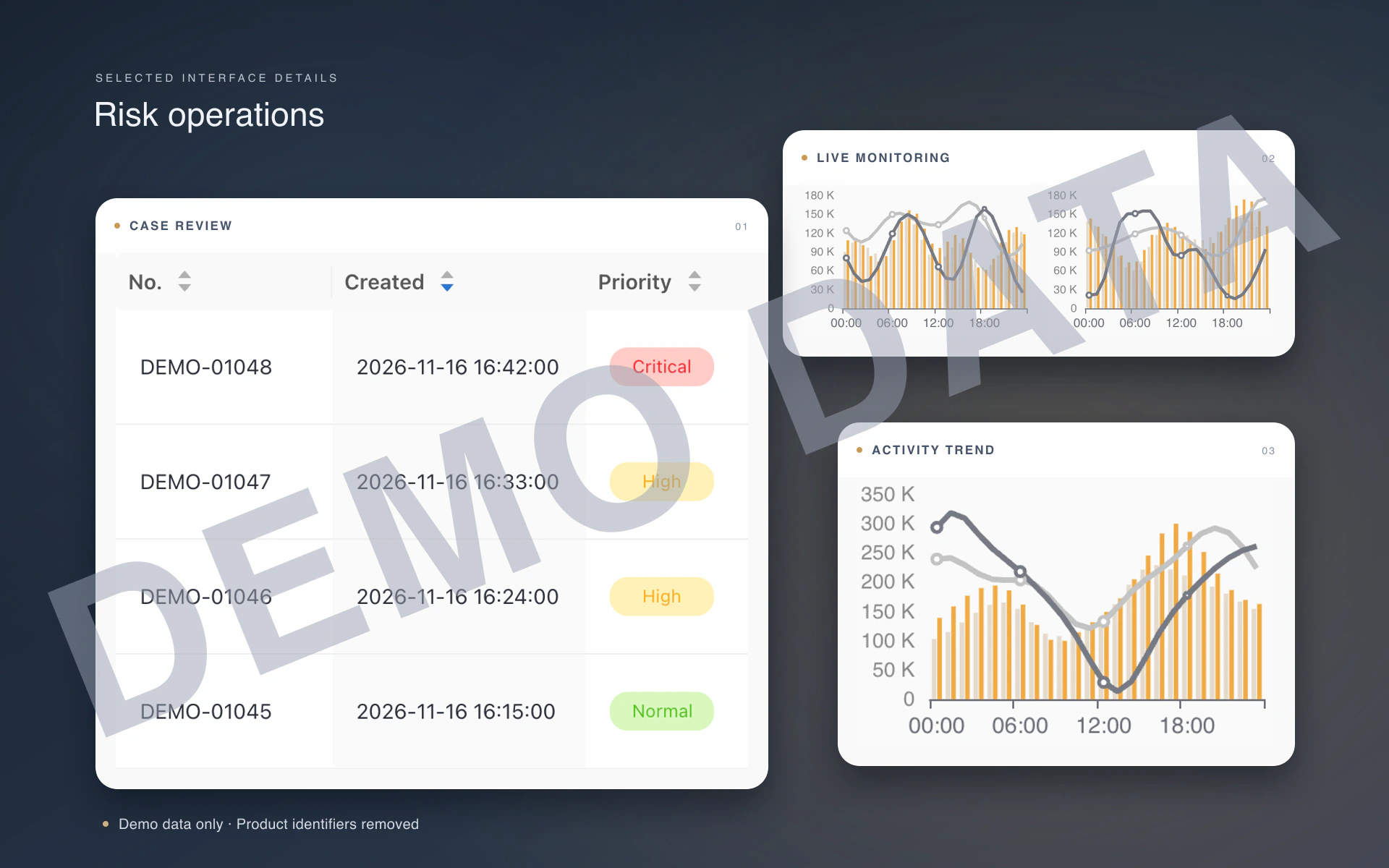
- Built monitoring views for in-game anomaly signals and player actions, such as bursts of repeated actions, abnormal logins and long idle periods.
- Built a risk-ticket list with accounts, times and anomaly types, and a case-review flow with escalation for unresolved tickets.
- Implemented login authentication and used back-end permissions to control which pages, features and data each role could see.
- Wrote the architecture documentation and used it, with code reviews, to hand the system over to an incoming engineer.
The incoming engineer shipped changes within two weeks and delivered a new feature on their own within two months.
The visuals use demo data with product identifiers removed.